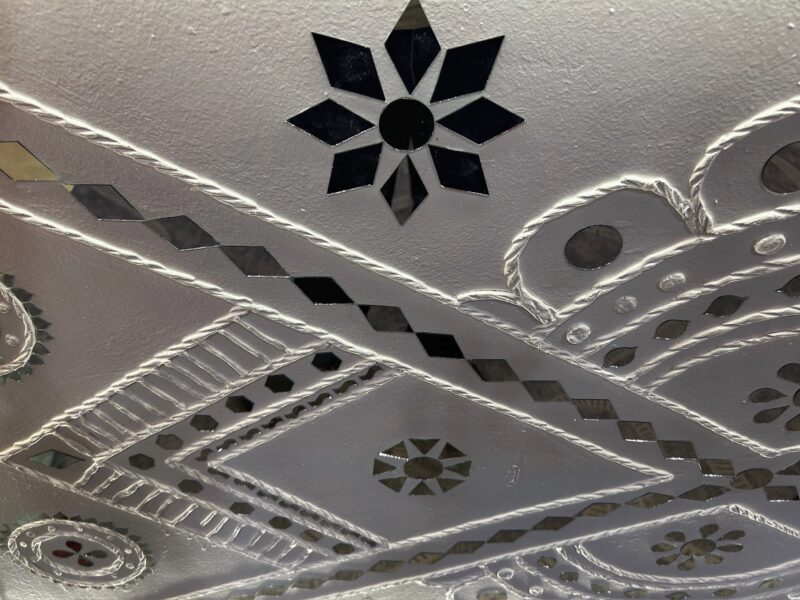
Under a crisp November sky, the endless white salt desert of Kutch glimmered like liquid glass. My husband and I were strolling through the bustling Rann Utsav when a mud wall caught our eye – it shimmered with thousands of tiny mirrors arranged in delicate white patterns. This was Lippan art, a folk‑craft that has decorated the homes of Kutch’s desert communities for generations.
Lippan Art: From the White Salt Desert to My Urban Apartment
Having grown up in the colourful city of Vadodara, I have always been surrounded by Gujarat’s rich cultural tapestry. As an art student, I dreamed of creating works that honored my heritage while speaking to contemporary, urban lives. The encounter at Rann Utsav became a turning point – I decided to bring the sparkling simplicity of Lippan art into my own compact living space.
The Cultural Roots of Lippan Art
Lippan art, also known as mud‑mirror work, originates in the remote villages of Kutch, Gujarat. It is traditionally practiced by the Rabari and Mutwa communities, who embellish the walls of Bhunga huts – circular homes built to withstand the harsh desert climate.
The medium is a unique blend of white mud (clay), cow‑dung, tiny glass mirrors, and natural pigments. Artists use this mixture to create geometric patterns that celebrate nature, spirituality, and community identity. Symbolic motifs include:
- Birds – freedom and the open sky.
- Flowers – beauty and abundance.
- Hindu symbols – protection, prosperity, and devotion.
“I saw it as more than art — it was a vibrant language of identity and tradition, woven seamlessly into everyday life.”
My Personal Journey: From Desert Murals to Cardboard Panels
After returning from the festival, I started experimenting at home. The workshops and a handful of online tutorials showed me how to translate the technique onto a much smaller, indoor-friendly scale.
Urban constraints meant I could not work with actual mud walls. Instead I used:
- Base – sturdy cardboard sheets (or canvas board).
- Clay substitute – Mould‑it.
- Paints – Gesso primer and a palette of acrylics.
- Mirrors – tiny craft mirrors (5‑10 mm) sourced from local markets or online.
- Adhesive – Fevicol for the mirrors; clear varnish for a protective finish.
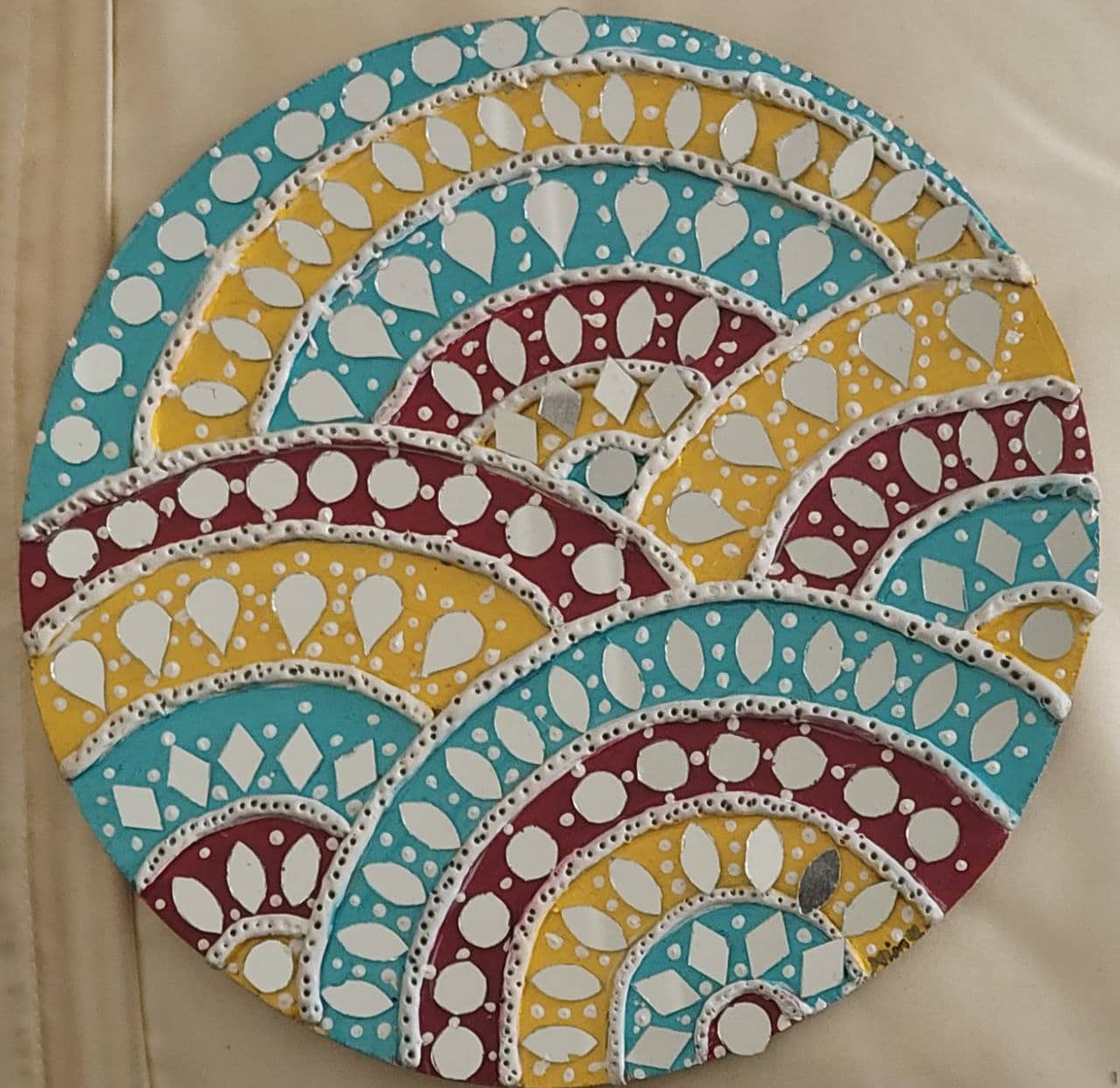
My first piece featured a stylised Lord Ganesh – the deity of new beginnings – surrounded by the classic chevron‑type mirror pattern. The result was a striking marriage of tradition and personal expression.

Showcase of Recent Works & Adaptations
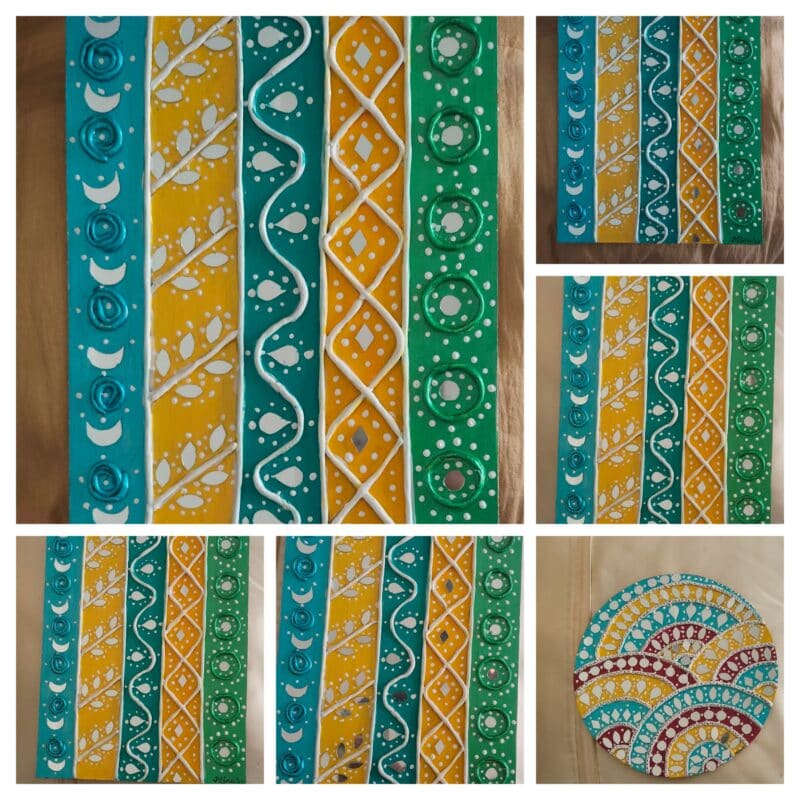
Below are some of the pieces I’ve created since that first experiment. Each retains the core spirit of Lippan – mirror embedding, earthy tones, and symbolic geometry – while using materials that are safe and durable for indoor environments.

Tips & Techniques for Aspiring Lippan Artists
Materials Checklist (all available on major e‑commerce sites)
- Base: Cardboard, thin plywood, or canvas board.
- Clay substitute: Mould‑it powder (or any air‑dry clay).
- Primer & Paint: Gesso and acrylic paints of your choice.
- Mirrors: Small craft mirrors (5‑10 mm).
- Adhesive & Finish: Fevicol, clear acrylic varnish, fine‑point brush for mandala‑dot accents.
Step‑by‑Step Process
- Sketch a simple pattern on the chosen base.
- Mix mould‑it and spread over the sketched lines.
- Allow the clay layer to dry at least for a day.
- Apply a thin coat of Gesso, then paint with acrylics.
- While the paint is still tacky, glue the tiny mirrors into the design.
- Finish with mandala‑style dots or additional paint accents.
- Seal the entire surface with clear varnish for durability.
Design Ideas
- Geometric chevrons, concentric circles, diamond grids.
- Nature motifs – birds, butterflies, stylised flowers.
- Spiritual symbols – Ganesh, Om, Swastik, lotus.
- Paisley and mandala patterns for textural depth.
Integration Tips for Small Spaces
- Hang as a focal wall piece above a neutral sofa or bookshelf.
- Use as a tabletop runner, decorative tray, or desk organizer.
- Keep the board size to around 60 × 80 cm for easy handling in apartments.
Preserving Heritage Through Innovation
This journey has proven that tradition and contemporary living can walk hand‑in‑hand. Lippan art is not merely a relic to be displayed in museums; it’s a living language that can adapt to modern interiors without losing its soul. By using urban‑friendly materials, I have re‑connected with my Gujarati roots while creating a fresh artistic voice that resonates with city dwellers.
Looking ahead, I plan to:
- Create larger, collaborative installations for community spaces.
- Host hands‑on workshops that teach city residents how to reinterpret Lippan art.
- Develop a limited‑edition series of wall‑hangings that blend traditional motifs with contemporary abstract forms.

Frequently Asked Questions
- What materials are traditionally used in Lippan art?
- White mud (clay), cow dung, tiny glass mirrors, and natural pigments sourced from local earth and plants.
- Can Lippan art be adapted for indoor spaces?
- Absolutely. By substituting mud with air‑dry clay (e.g., Mould‑it), using cardboard or plywood as a base, and acrylic paints instead of natural pigments, the technique works beautifully in apartments and offices.
- How does Lippan art compare to other Indian folk arts?
- Its hallmark is the mirror work combined with geometric patterns. While Warli art also reflects community identity, Lippan’s reflective elements set it apart.
Multilingual Summary
Gujarati: લિપ્પણ કલા गुजरातની પરંપરાગત કલા છે, જે આજે નગર જીવનમાં નવું આકાર લે રહી છે.
Hindi: लिप्पन कला गुजरात की पारंपरिक कला है, जो अब शहरी जीवन में नया रूप ले रही है।
Marathi: लिप्पण कला ही गुजरातमधील पारंपरिक कला असून ती आता शहरी जीवनात नवीन रूप घेत आहे.

Have you tried adapting any folk art at home? Share your photos, questions, or stories in the comments below. Let’s keep the craft alive together!